Published November 3, 2026 · TallyTidy
The 52-week savings challenge is one of the simplest saving plans there is: in week 1 you save $1, in week 2 you save $2, and so on until week 52, when you save $52. By the end of the year you have saved $1,378 without ever setting aside a large amount at once. This guide explains how the challenge works, popular variations, and how to set up a 52-week savings challenge tracker that keeps you going past the first few weeks.
The total is the sum of the numbers 1 to 52: 52 × 53 ÷ 2 = 1,378. The weekly amount grows by $1 each week, so early weeks are easy and the last quarter is the hardest.
| Quarter | Weeks | Saved that quarter | Running total |
|---|---|---|---|
| Q1 | 1–13 | $91 | $91 |
| Q2 | 14–26 | $260 | $351 |
| Q3 | 27–39 | $429 | $780 |
| Q4 | 40–52 | $598 | $1,378 |
Notice that Q4 asks for more than six times as much as Q1. That matters if Q4 falls in November and December, when holiday spending peaks.
A named goal, like "emergency fund", "holiday 2027" or "car insurance renewal", makes the challenge easier to finish than saving for nothing in particular. If you are saving for several known costs, you may prefer sinking funds.
A separate savings account, ideally a high-yield one, keeps the money out of everyday spending. Cash in an envelope works too, but it is easier to dip into and earns nothing.
You do not need to start on January 1. Start any Monday. Check where the hardest weeks will fall and choose the reverse or pick-a-box version if they land in an expensive month.
Some banks let you schedule transfers; set a recurring weekly transfer and change the amount once a month, or use the fixed-amount variation and automate it fully.
Your tracker should show the week number, planned amount, a checkbox, and the running total. On paper, coloring in each week as you save is the satisfying part. In a spreadsheet, the running total is =SUM($B$2:B2) copied down, and a progress percentage is the running total divided by 1,378.
The challenge works because each week is small and the progress is visible. Put the tracker where you will see it: on the fridge, inside a planner cover, or pinned as the first tab in your budget spreadsheet. Some people write the goal amount and date at the top in large numbers, and add a note of what the money is for. When the running total reaches milestones such as $100, $500 and $1,000, mark them on the tracker. Small, specific milestones make the long middle of the year feel shorter.
| Week | Classic | Reverse | Classic running total |
|---|---|---|---|
| 1 | $1 | $52 | $1 |
| 10 | $10 | $43 | $55 |
| 26 | $26 | $27 | $351 |
| 40 | $40 | $13 | $820 |
| 52 | $52 | $1 | $1,378 |
It works best as a habit builder for people who find it hard to start saving, and as a buffer for those paying off debt. If you already save a fixed percentage of income automatically, the challenge adds little, though some people enjoy running it on top as a "fun money" fund. If you carry high-interest credit card debt, it often makes sense to build a small emergency fund with the challenge and put the rest toward debt; see our debt payoff tracker guide.
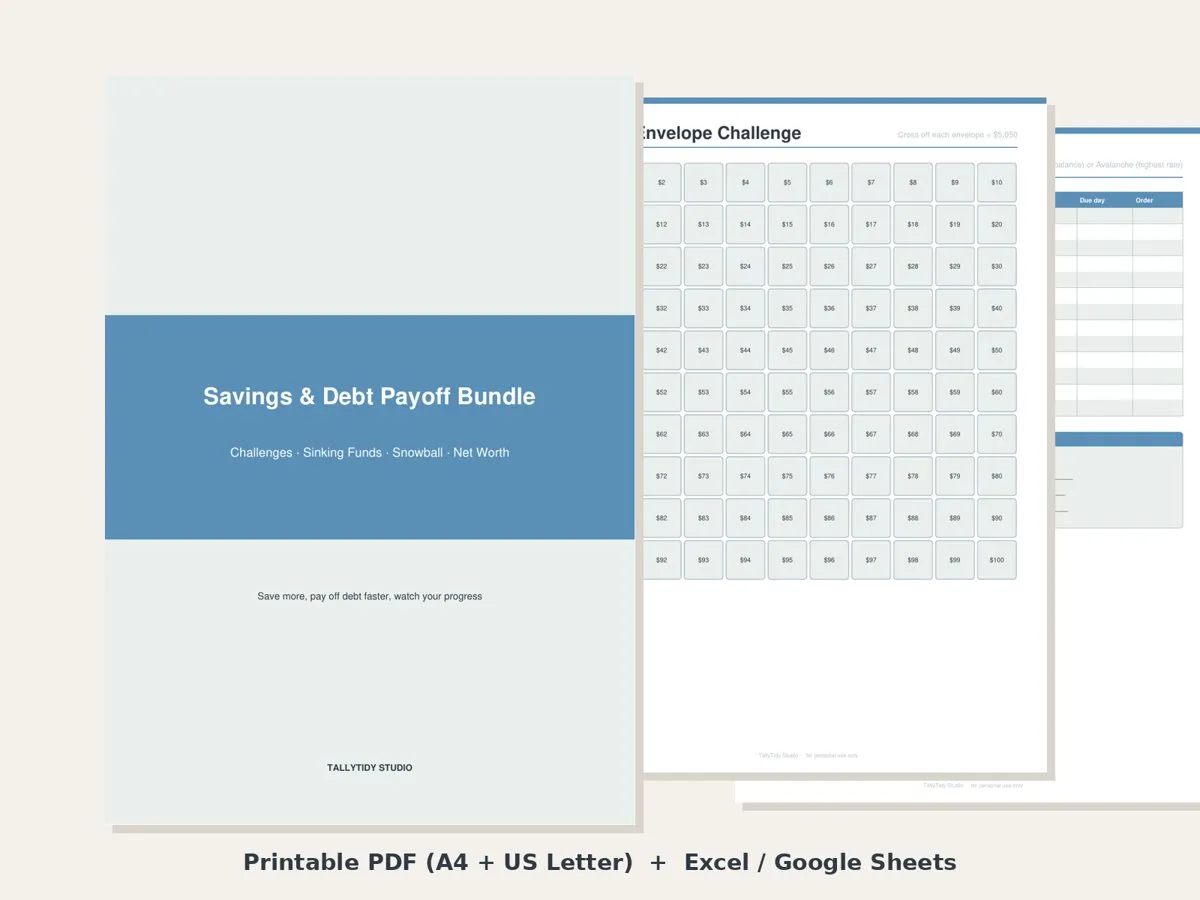
The Savings Challenge & Debt Payoff Tracker Bundle includes 52-week challenge pages (classic and reverse), savings goal trackers with color-in progress charts, and debt payoff pages, so you can track saving and debt payoff side by side. For a full year of budgeting alongside it, see the 2027 Budget Planner.
$1,378 in the classic version, plus any interest your savings account pays.
Yes. The challenge is 52 weeks from whenever you begin.
Many people find it easier because the large amounts come when motivation is highest and the year ends with small amounts during the holidays.
General educational information, not financial advice.
Free tool: Savings goal calculator – see how much to save each month to hit your goal.